Case findings and discussion
Adolescent female was referred to ultrasound with complaints of dysmenorrhea.
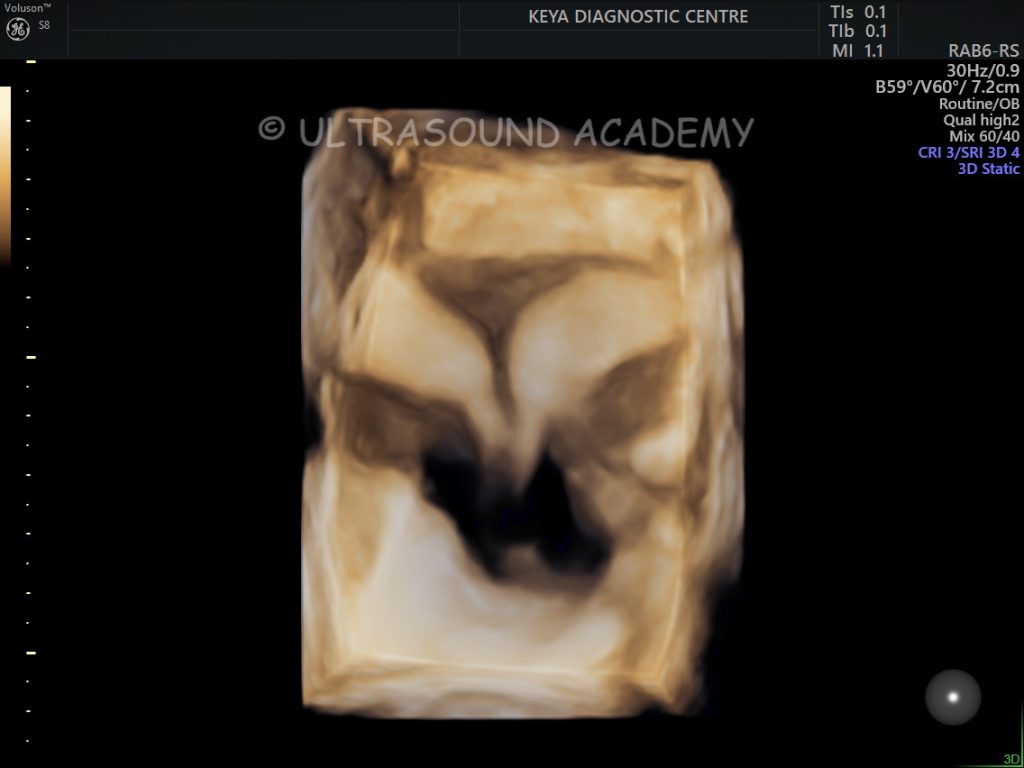
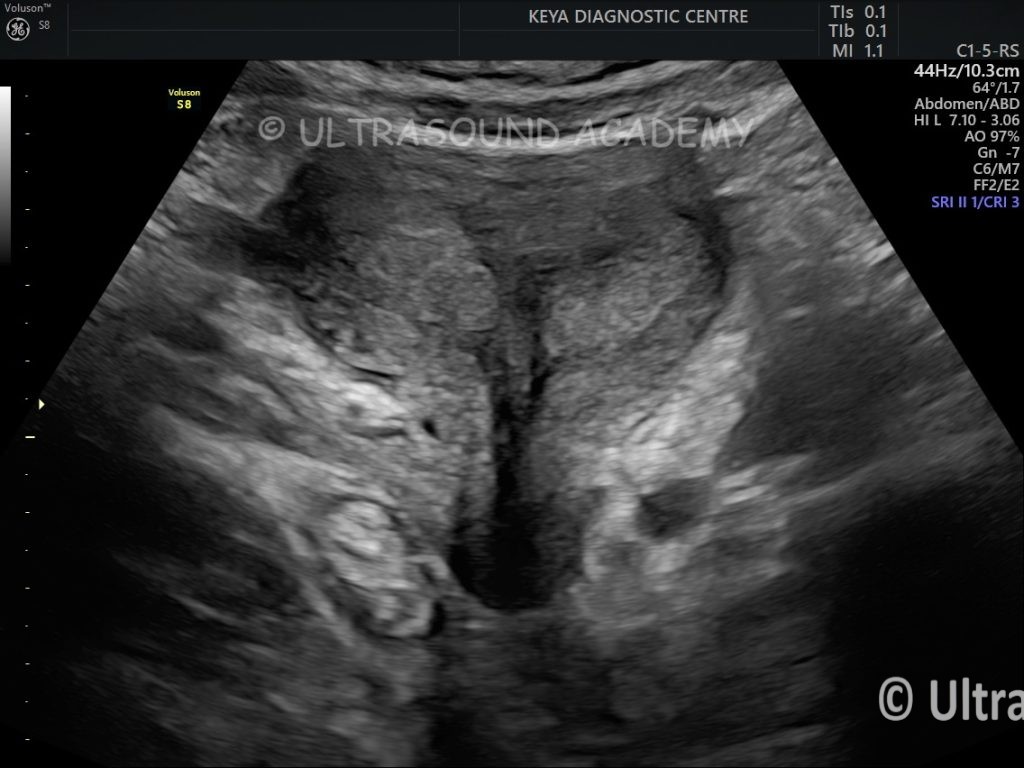
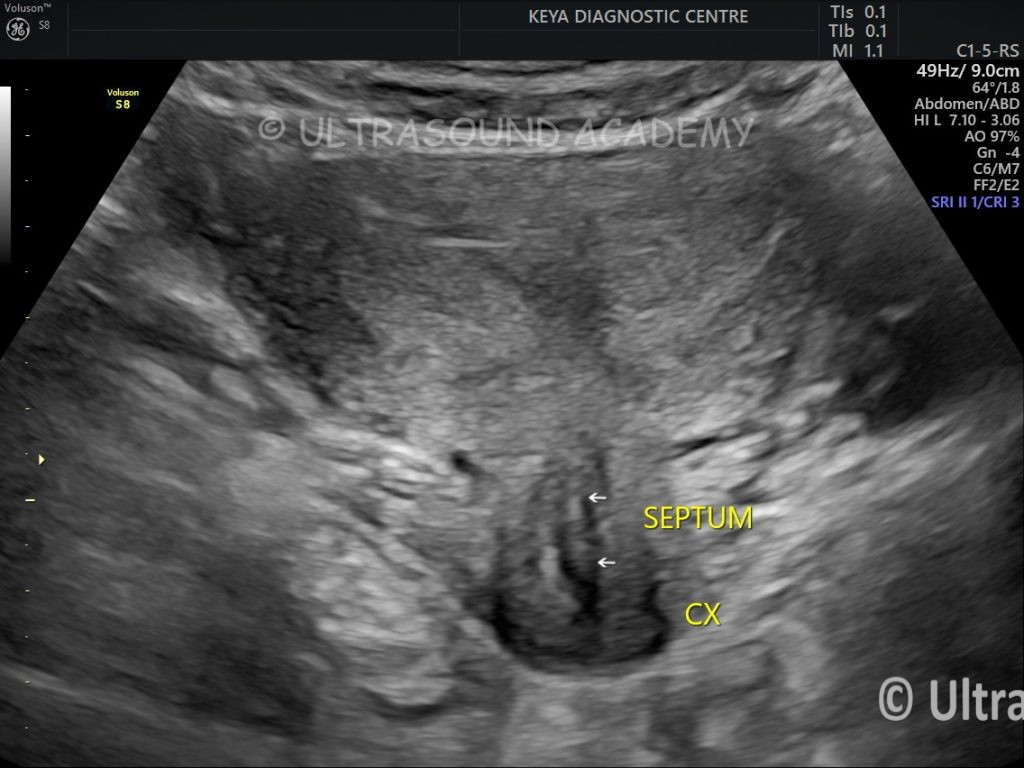
Hypoechoic septum is seen extending from fundus upto distal part of cervical canal.
No fundal indentation is seen.
No fluid is seen in endometrial cavity or cervical canals.
The ESHRE/ESGE (European Society of Human Reproduction and Embryology/European Society for Gynaecological Endoscopy) classification system for Müllerian anomalies is a widely used categorization system. It provides a standardized way to classify congenital uterine anomalies based on uterine anatomy and morphology, focusing on the degree of uterine cavity distortion. It categorizes anomalies into seven main groups:
Class U0: Normal Uterus
A normal, unremarkable uterine cavity with no structural anomalies.
Class U1: Dysmorphic Uterus
Normal external contour but abnormal endometrial cavity shape. Examples:
U1a: Hypoplastic uterus (small endometrial cavity).
U1b: T-shaped uterus (narrow endometrial cavity with thick walls).
Class U2: Septate Uterus
A uterus with an abnormally thickened septum dividing the endometrial cavity partially or completely.
External contour is normal (<30° angle).
U2a: Partial septum (not reaching the cervix).
U2b: Complete septum (extending to the cervix).
Class U3: Unicornuate Uterus
A uterus formed from a single Müllerian duct with one functional or non-functional cavity.
U3a: With functional rudimentary cavity.
U3b: Without functional rudimentary cavity.
Class U4: Bicorporeal Uterus
External contour shows a separation (>105° angle between cavities).
U4a: Partial (two cavities, partially divided).
U4b: Complete (two separate endometrial cavities, two uterine horns).
U4c: Bicorporeal septate uterus (features of both U2 and U4).
Class U5: Aplastic Uterus
Complete absence of functional uterine cavity.
U5a: Symmetrical aplasia/hypoplasia (both Müllerian ducts affected equally).
U5b: Asymmetrical aplasia/hypoplasia (one duct affected more than the other).
Class U6: Other Anomalies
Complex cases that do not fit into the above categories, including combinations of anomalies or rare congenital conditions like:
Hypoplastic conditions with atypical presentations.
Diethylstilbestrol (DES)-related anomalies.
This classification emphasizes diagnostic imaging (e.g., ultrasound, MRI, hysteroscopy) for precise evaluation. It replaced earlier systems (like the ASRM classification) due to its focus on cavity morphology and clinical relevance.